
What Can a Single Drop of Blood Really Tell Us?
Live Blood Analysis begins with something remarkably simple: a single drop of blood.
Under a microscope, however, it becomes something entirely different.
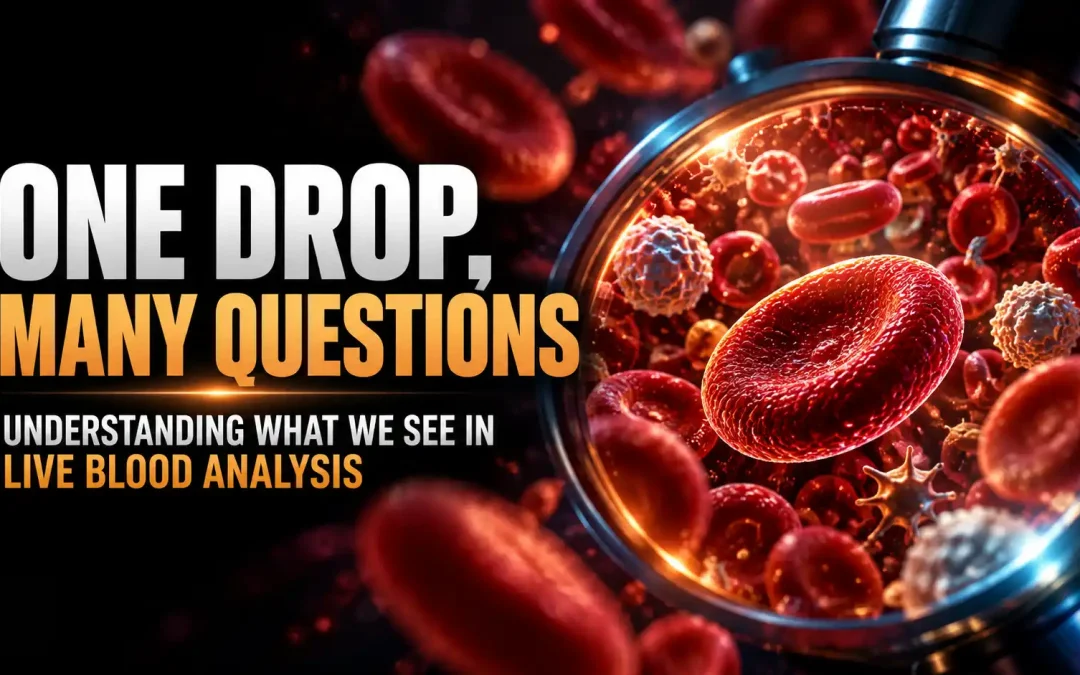
Red blood cells move across the field of view. White blood cells appear among them. Platelets and plasma form part of a constantly changing microscopic landscape.
For many people, Live Blood Analysis is the first opportunity to see their own blood while it is still fresh.
And once you see it, the questions begin.
Why do some cells look different? Why are certain cells grouped together? What can we learn from their appearance – and what can’t we?
That is where the real value of Live Blood Analysis begins.
What Are We Actually Looking At?
Blood is far more than a red liquid moving through the body.
It transports oxygen, nutrients, hormones, immune cells and waste products, while playing a central role in circulation, immunity and tissue function.
During Live Blood Analysis, several major components may be visible.
Red blood cells make up most of what we see. Their primary role is to transport oxygen throughout the body.
White blood cells form part of the immune system and help the body respond to infection, inflammation and other challenges.
Platelets are small cellular fragments involved in blood clotting and tissue repair.
All of these are suspended within plasma, the liquid portion of blood.
Seeing these structures on screen can turn something normally invisible into something very real.
Why Look at Blood While It Is Fresh?
Live Blood Analysis differs from conventional laboratory testing.
Traditional pathology tests measure specific values such as haemoglobin, glucose, cholesterol, hormones, vitamins or numbers of particular blood cells.
Laboratory blood smears may also be stained and examined in detail to assess the size, shape and appearance of cells.
Live Blood Analysis takes another approach.
A small fingertip sample is examined shortly after collection, allowing you to see the sample live on screen while the practitioner explains what is being observed.
This immediacy is one of the most engaging parts of the experience.
At Exodus Immunology, we use Live Blood Analysis as a complementary educational and wellness tool, rather than as a replacement for conventional medical diagnosis or laboratory testing.
Cell Shape Can Tell Us Something – But Not Everything
One of the most interesting aspects of microscopy is cell morphology – the study of cell size, shape and appearance.
Blood cells are not always visually identical.
Changes in shape, size, colour or arrangement can sometimes provide useful observations.
But there is an important difference between:
“We can see a pattern.”
and
“This pattern proves a specific condition.”
Those are not the same thing.
A microscopic observation may provide a reason to ask more questions, look at lifestyle factors or consider whether further clinical testing is appropriate.
It should not be interpreted in isolation.
The Sample Changes Once It Leaves the Body
This is one of the most important parts of understanding Live Blood Analysis.
Once blood leaves the circulation, its environment begins to change.
It is no longer moving through blood vessels at body temperature or under exactly the same conditions that exist inside the body.
Over time, cells and other components of the sample may begin to change as well.
That means timing, sample preparation and careful interpretation matter.
Not every unusual-looking structure beneath the microscope represents a disease, organism or health problem.
Sometimes the most responsible conclusion is simply:
This is an observation worth discussing.
What Can Live Blood Analysis Add?
If Live Blood Analysis is not a diagnostic replacement for conventional blood testing, where does its value lie?
For many people, the answer is understanding.
Health information can often feel abstract.
A laboratory report may contain pages of numbers and reference ranges, while microscopy lets you see your own blood directly on screen.
That creates an opportunity to discuss the bigger picture.
Hydration.
Sleep.
Stress.
Lifestyle.
Existing symptoms.
Previous laboratory results.
And whether further investigation may be appropriate.
Rather than simply being given information, you become part of the conversation.
What Live Blood Analysis Cannot Do
Responsible wellness care also means being clear about limitations.
Live Blood Analysis should not be used on its own to diagnose a medical condition, confirm an infection, determine exact vitamin or mineral levels or replace conventional blood investigations.
Conditions such as anaemia, diabetes, thyroid disorders, hormonal abnormalities and nutritional deficiencies require appropriate clinical assessment and validated laboratory testing.
Where something requires further investigation, conventional testing remains essential.
Being clear about those limitations does not make Live Blood Analysis less valuable.
It simply gives it the correct role.
Seeing Your Own Blood Changes the Conversation
Perhaps the most interesting part of Live Blood Analysis is not simply what appears beneath the microscope.
It is the questions it creates.
Am I drinking enough water?
Is my nutrition supporting my body properly?
Could my lifestyle be influencing how I feel?
Should I investigate something further?
That curiosity can be valuable.
Because better health decisions do not always begin with an immediate answer.
Sometimes they begin with a better question.
The Exodus Difference
At Exodus Immunology, Live Blood Analysis forms part of a broader conversation about your health and wellbeing.
Our approach is simple:
Observe carefully.
Ask questions.
Consider the whole person.
Investigate appropriately.
We do not believe a single drop of blood should be expected to explain everything happening in the human body.
But it can provide a fascinating starting point.
The microscope can show us patterns.
It can make something normally invisible visible.
And it can encourage a more informed conversation about your health.
One Drop. Many Questions.
Live Blood Analysis offers a rare opportunity to see your own blood cells in real time while the observations are explained to you.
It does not provide every answer.
Nor should it.
Its value lies in helping you look, question, understand and – when necessary -investigate further.
Sometimes one small drop is simply where the conversation begins.
Curious to See Your Own Blood?
Discover Live Blood Analysis at Exodus Immunology in Sea Point, Cape Town.
Learn more about Live Blood Analysis